Showing posts with label Kerala Food Items. Show all posts

Chemmeen Ularthiyathu

Posted by Rashid Areacode (9895261956) On 4:30:00 AM


Preparation time: 30 minutes Cooking time: 30 Minutes Serves: 6-8
A traditional prawn preparation that brings out the exquisite taste of prawns. It is served as a side dish with rice. A favorite of my children. This dish is traditionally prepared in earthen vessels and tastes best when cooked that way.


Ingredients:
500gms. (cleaned and de-veined)
100 gms. ( cut into ½ inch long and ¼ inch thick pieces)
5 gms.( cut into two)
5 gms. (cut into tiny pieces)
25 gms. ( cut into thin slices)
1 ½ tsp.
½ tsp
1 ½ springs (leaves separated)
10 gms.
175 ml.
1 ½ tsp.
200ml.
½ tsp.
25gms. ( sliced fine).
2 springs
Method of preparation:
• Soak the cocum in little water for sometime.
• Heat oil and add mustard.
• When the mustard crackles, add the sliced shallots, curry leaves and fry.
• Remove and keep aside.
• Add all the ingredients to the cleaned prawns.
• Add the soaked cocum and the water in which it was soaked and mix well.
• Add water and cook for 15minutes.
• Allow the water to dry. Remove from fire .
• Then add the seasoning and saute for 10 minutes.
• Remove from fire and serve.

Dosa

Posted by Rashid Areacode (9895261956) On 4:31:00 AM


Dosa shell:
1 1/2 cups rice
1/2 cup urad dal
salt to taste
Oil

Masala Filling:
2 large potatoes
1 medium onion (chopped)
1/2 teaspoon yellow split peas
1/2 teaspoon mustard seed
1/2 teaspoon turmeric
1-2 green chili
1 tablespoon oil
salt to taste
Preparation:
Dosa shell
Separately soak rice and urad dal at least 6 hour or overnight in water.
Grind to paste.

Mix together, add salt with water to make batter.
Leave in room temperature overnight.
Mix onion and chilies to the thin batter.
Heat pan or griddle with little ghee or oil.
Spread the mix on pan in circular motion to make thin Dosa.
Cook on both the sides, if desired.

Masala Filling (Spicy Filling): 
Heat oil. Add mustard seed, peas, onions and spice.
Fry for about 5 minutes on medium heat or/until onions are turned into golden brown
Add potatoes and mix and cook some more Serve
Add filling inside Dosa and roll. Serve hot with Chutney.

Variations of Dosa

Though dosa typically refers to the version made with rice and lentils, many other versions of dosa exist and are popular in varying degrees. This is sometimes specific to a region in India. Other types of dosa include:
  • Egg dosa - a dosa spread with an omelette.
  • Chilli dosa - chilli powder is spread on the dosa.
  • Open dosa - chutney powder is spread on the dosa while cooking. Before serving spiced & mashed potato is placed on top.
  • Onion dosa - chopped and sautéd onions are spread on the dosa.
  • Ghee (thuppa/neyyi) dosa - ghee is used instead of oil while frying the dosa.
  • Butter dosa - butter is used instead of oil while frying dosa and a small amount on top of it while serving.
  • Roast - the dosa is spread thinly and fried until crisp.
  • Kerala Dosa - a different kind of traditional dosa, that is small, thick, soft and spongy.More like a pancake and somewhat similar to appam, with the difference that it is flat and that dal is used in the batter.
  • Family roast - a long dosa which can be spread over 2 or 3 feet.
  • Paper dosa - a long and very thin delicate dosa which can be spread over 2 feet.
  • Green dosa - a dosa stuffed with fresh vegetables and mint chutney.
  • Chow-chow dosa - a dosa stuffed with (Indian flavored) Chinese noodles.
  • Cheese dosa - a dosa stuffed with cheese.
  • Masala dosa - a dosa stuffed with spiced potatoes (famous in South India).
  • Methi dosa - a dosa flavoured with fenugreek.
Rava dosa.
  • Rava dosa - made with rava or semolina, which doesn't need fermentation and is usually considered a fast snack/tiffin.
  • Wheat dosa - made with wheat flour, and served with coconut chutney, mysore masala dosa
  • Vella dosa - a sweet dosa made of jaggery with ghee/neyyi.
  • Ragi Dosa - made of ragi or millet flour, usually considered "a poor man's fare".
  • Muttai dosa - eggs are added to the regular batter; the word muttai in Tamil means "egg".
  • Oothappam - Thick round dosa in Tamilnadu.
  • Set dose - a popular type of dosa in Karnataka, which is cooked only on one side and is served in a set of two to three, hence the name.
  • Benne dose - similar to masala or set dosa but smaller in size. Served with liberal helpings of butter sprinkled on it. Said to have originated in the Davanagere district of the state of Karnataka
  • Cabbage dosa - a dosa made out of cabbage. Paste is prepared with rice, red chillies, Asfotedia and Turmeric. Once the batter is ready, cabbage cut into small pieces is added to the paste and left for about 30 mins. Once this is done, the batter is poured and the dosa is made crisp.
  • Neer dosa - a dosa prepared from rice unique to Dakshina Kannada, Udupi and Uttara Kannada districts.
  • 70 MM Dosa - similar to Masala Dosa, but it is bigger in size, about 60 cm in diameter.
  • American chopsuey dosa - Dosa served with a filling of fried noodles and tomato ketchup.
  • Uppu puli Dosa - It is dosa made by adding Uppu (salt) and Puli (Tamrind) with dosa batter. It is an variety of dosa which are part of Udupi cuisine.

Masala dosa

Masala dosa showing potato masala filling
The ubiquitous Indian dish, masala dosa has its origins in Udupi, Karnataka.A masala dosa is made by stuffing a dosa with a lightly cooked filling of potatoes, fried onions and spices. It wraps the dosa around an onion and potato curry or sabji.
Before it was invented, plain dosa was served with potato curry (batata bhaji) without onions in a separate cup. During a shortage of potatoes, method was created where potato was mashed and sauteed with onions together with other spices. This was then placed inside the dosa instead of a separate cup. This was done to hide the onions which are not eaten by orthodox Hindus and Jains. People enjoyed this new dosa. It came to be known as "Masala Dosa", from the sautéeing of spices (masala) during the preparation of the bhaji.
Due to the huge popularity of masala dosa, many variants exist for differing tastes. The following are some of the variants:
· Mysore masala dosa: Masala dosa with chutney spread inside along with bhaji.
· Vegetable masala dosa: Instead of potatoes, peas and other vegetables are mashed to make bhaji.
· Rava masala dosa: Rava (semolina), especially the Bombay Rava, is used to instead of rice.
· Chinese Masala dosa: Noodles and other Chinese ingredients like schezwan sauce are added.
· Paneer Chilli Dosa: The dosa is stuffed with sauteed cottage cheese (paneer) and capsicum (Bell pepper).
· Palak Masala Dosa: The dosa is coated with a thin layer of puréed spinach, and filled with the traditional potato/onion mixture.
· Masala dosa with one or two fried eggs served on top of it (a possible variation of the egg hopper).
One variant of the masala dosa, the Mysore masala dosa, is served with both coconut and onion chutneys. In Bangalore, the masala dosa is usually served with a red chutney applied to its inside surface. This peculiarity lends itself to a unique taste. The red chutney usually has generous amounts of garlic (traditionally garlic is not used in masala dosa especially in the Brahmin community), and adds a nice flavor to the dosa when it is fried with ghee. In recent times this has become popular in other parts of Karnataka. Davanagere benne masala dosa is another variant of the masala dosa from Karnataka. It is named after Davanagere in Karnataka. It is prepared by adding liberal doses of butter (benne) and also a potato filling (palya) that is unique. It is devoid mostly of any extra ingredients and is just mashed potato. The Rava dosa or Rave dosay is another variant which is made from semolina. Ragi dosa and Ade or Aday dosa are other variants that are native to Karnataka.
Dosa is made in every part of South India and the Dosas prepared in North India are generally of the Karnataka type.

Puttu

Posted by Rashid Areacode (9895261956) On 7:29:00 AM


Puttu is a very famous Kerala Breakfast which is made using Rice Flour, Wheat Flour or even Rava. It is eaten along with sweet bananas, especially cheru pazham. Some people prefer having Puttu along with Egg Curry, Kadala (Bengal Gram) Curry, Cheru Payaru (Green Gram) Curry etc.

Ingredients
Puttu Podi / Fried Rice Powder – 2 cups
Grated Coconut – 1/2 cup
Grated Cumin – 1 tsp
Salt – As required
Sugar – 1/2 tsp
Luke Warm Water – Around 1/2 – 3/4 cup


Rice Powder after mixing with water


Grated Coconut


Preparation Method
Mix little salt in half to 3/4 cup of warm water.
Mix 1/2 tsp of grated cumin and 1/2 tsp of sugar with the rice powder.
Sprinkle water on the rice powder and start mixing it so as to make the powder wet.
Keep on sprinkling water and continue mixing, till u can make lumps when you clasp but which can be easily crumbled.
After the mixture has enough moisture, run it in a grinder for a few seconds so that there are no lumps.
For making Puttu, there is a special vessel known as Puttu Kutti which is placed on top of another vessel called Puttu Kudam.
Fill the PuttuKudam with water, not more than half its capacity.
Place a handful of grated coconut in the Puttukutty (special utensil) and then add the rice mixture till half, now add another handful of grated coconut. Continue adding rice mixture and top it with some coconut.
Close the lid and place the PuttuKutti on the PuttuKuddam and steam the Puttu for about 10-12 minutes.
It is ready to be served with Mutta Curry or Kadala Curry or even with bananas.


Puttu Kutti


Biryani

Posted by Rashid Areacode (9895261956) On 3:02:00 AM

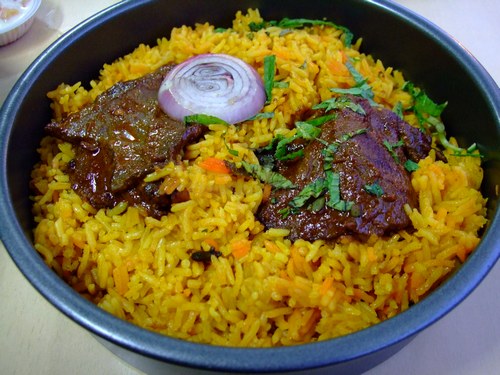
Biryani, biriani, or beriani: is a set of rice-based foods made with spices, rice (usually basmati) and meat, fish, eggs or vegetables. The name is derived from the Persian word beryā(n) (بریان) which means "fried" or "roasted".

Biryani was originated in Iran (Persia) and it was brought to the South Asia by Iranian travelers and merchants. Local variants of this dish are not only popular in South Asia but also in Arabia and within various South Asian communities in Western countries.
Ingredients
The spices and condiments used in biryani may include but are not limited to: ghee, cumin, cloves, cardamom, cinnamon, bay leaves, coriander, mint leaves, ginger, onions, and garlic. The premium varieties include saffron. For a non-vegetarian biryani, the main ingredient that accompanies the spices is the meat—beef, chicken, goat, lamb, fish or shrimp. The dish may be served with dahi chutney or Raita, korma, curry, a sour dish of eggplant (brinjal) or a boiled egg.
The difference between biryani and pullao is that while pullao may be made by cooking the items together, biryani is used to denote a dish where the rice (plain or fried) is cooked separately from the thick sauce (curry of meat or vegetables). The curry and the rice are then brought together and layered, resulting in a dish of the contrasting flavors of unflavored rice (which has a hint of the aromas and juices of the curry) and intensely flavored sauce and meat or vegetables.

Types

Hyderabadi Biryani
Non-vegetarian Hyderabadi Biryani is savored in all parts of India and forms an integral part of Indian cuisine. The Nizam’s kitchen boasted of 49 kinds, which included biryani made from fish, quail, shrimp, deer and hare. The most famous of all, Hyderabadi Biryani is called the "Kachi Akhni" Biryani as both the marinated meat and the rice are cooked together.


Dindigul Biriyani
Dindigul Biriyani- Dindigul is very famous for its Briyani and also called Briyani City. Briyani prepared in Dindigul uses a small rice called seeraga samba and with special ingredients.It gave tamilnadu the best of its taste. Thalappakatti in itself is a brand name which operates all over Tamilnadu with so many retail outlets. Venu Briyani, Ponram, Thulsi and Bangaru are the Best Briyani hotels in Dindigul. Aachi's also holds good in its flavour.


Iranian Biryani
In Safavid dynasty a dish called "Biryan Pilaf" was made with overnight marinated lamb/chicken - with yogurt, herbs, spices, dried fruits like raisins, prunes or pomegranate seeds - and later cooked in Tandoor / Tanoor oven. It was served with steamed rice. In its more original form, in some cities the dish is known with the general name of "Dam Pukht/Dam-pukhtak". The compound in Persian means "steam-cooked"—a reference to the steamed rice that forms the basis of the dish. This name is still in common use in Iran besides "biryani". In Southeast Asian countries such as Burma/Myanmar this older, general Persian term is in common use as 'danpauk'.
In city of Isfahan, Iran; a kind of Biryani is made with cooked mutton or lamb that is stewed then minced separately and then grilled in special small round shallow pans in the oven or over the fire. The burgers are generally served, with powdered cinnamon, in a local bread, usually "nan-e taftoon" but also sometimes "nan-e sangak".

Sindhi Biryani
The Sindhi Biryani variant of Biryani is very popular in Pakistani cuisine and Biryani of all types are eaten in all parts of Pakistan and the world. In Pakistan Biryani enjoys substantial popularity, particularly in the cities of Karachi and Hyderabad, where the chicken version is popular. most Biryani cuisines in Pakistan combine elements of Sindhi Biryani such as the common use of Yogurt recipes. The national flag carrier, PIA, also serves this cuisine for most of its western bound flights to give foreigners a feel of Pakistani cuisines.
There is also another meat free version prepared in the Punjab and northern areas of Pakistan that has proved quite popular and to meet the dietary requirements. The dish offers the usual local vegetables as well as a sour yogurt to cool off the stomach from the spices.

Memoni Biryani
Memoni biryani was developed by the Memon ethnic group and is very similar to Sindhi Biryani. It has variations though, among families, as do most biryanis, though the Batwa Memon community most commonly makes biryani in this form. Memoni biryani is made with lamb, yogurt, fried onions, and potatoes, and less tomatoes compared to Sindhi biryani. Memoni biryani also uses less food coloring compared to other biryanis, allowing the rich colors of the various meats, rice, and vegetables to blend without too much of the orange coloring. Memoni biryani is especially notable in Karachi, Pakistan.

Kacchi Biryani
Kacchi Biryani is a special preparation of the dish which is cooked with mutton (and rarely with Chicken). The dish is cooked with the meat and sauce being at the bottom of the cooking pot with a thick layer of rice on top, the rice and meat are mixed before serving. Potatoes are sometimes also added to the dish which is cooked with the meat. A boiled egg and mixed salad often accompanies the dish. This is one of the most popular delicacy of Old Dhaka, Bangladesh.
Tahari
Tahari or Tahri is the name given to the vegetarian version of the Biryani and is very popular in Pakistani and Indian homes. In Bangladesh, Tehri refers to Biryani prepared by adding the meat to the rice, as opposed to traditional Biryani where the rice is added to the meat.

Lucknowi (Awadhi) Biryani
Lucknow and biryani have an almost symbiotic relationship. The Lucknow (Awadhi) biryani is the footprint that the Muslims of the Mughal Empire left on the northern part of India. It originated in the village 'Bare Next' and although it originated in the North, Virani Biryani has also picked up flavors of the South. The Awadhi Biryani is also known as "Pukka" Biryani as the rice and meat are cooked separately and then layered.


Calcutta Biryani
The third in the list of famous Biriyanis, Calcutta or Kolkata biryani evolved from the Lucknow style when Wajid Ali Shah, the last nawab of Awadh was exiled in 1856 to the Kolkata suburb of Metiabruz. When the biryani entered poorer homes in the city that could not afford meat, at least on a regular basis, the meat was replaced by potatoes. Now the use of potatoes has become a distinct feature of the Calcutta biryani as an additional ingredient along with the meat. In addition, Calcutta biriyani is much lighter on masala and more subtle, unlike its Hyderabadi counterpart.

Kozhikode Biryani
The Kozhikode Biriyani variant of biryani is very popular in Kerala cuisine introduced by Muslims. This preparation is popular across the coast of Kerala—the Malabar region particularly. The biriyani may contain chicken, mutton or fish as the main ingredient. The biriyani is quite different from others across India in that the rice used is generally mixed with ghee to produce a very rich flavour. Although local spices such as nutmeg, cashew, cloves and cinnamon are used, there is only a small amount of chilli (or chilli powder) used in the preparation making the dish much less spicy in comparison to other biriyanis from across India. It is also known as Thalasseri biriyani.

Danbauk
In Myanmar, biryani, known in Burmese as danpauk/danbauk or danpauk htamin is popular. Popular ingredients are cashew nuts, yogurt, raisins and peas, chicken, cloves, cinnamon, saffron and bayleaf. In Burmese biryani, the chicken is cooked with the rice. Biryani is also eaten with a salad of sliced onions and cucumber. In Yangon, there are several restaurant chains that serve biryani exclusively. It is often served at religious ceremonies and luncheons. Biryani in Myanmar utilizes a special rice grown domestically rather than basmati.


Thallapakattu Briyani
This variety of briyani is quite popular in south india particularly in tamil nadu.There are quite a number of hotels serving this type of briyani.Thallapakattu literally means turban in Tamil.


Thai Biryani
In Thailand, Thai Muslims have popularized a local variety of the dish, known as Khao mok, which is popular throughout the country.Chicken and beef are the most common form but there is also a goat version that is eaten almost exclusively by the Muslim population. Along with Thai Massaman curry and satay it is one of the most notable Muslim Thai dishes. Biryani is also another name for heena.


Sri Lankan Biryani
Malay Biryani prepared with Sri Lankan Spices
In Sri Lanka Biryani is most popular amongst Muslims and is usually served with chicken, beef or mutton. In many cases, Sri Lankan biryani is much spicier than most Indian varieties. Popular side dishes include Acchar, Malay Pickle, cashew curry and
Ground Mint Sambol.
A popular form of biryani uses string hoppers as a substitute for rice. It is often served with scrambled eggs or vegetables.


Malaysia's Nasi Beriani
In Malaysia and Singapore, the dish is called Nasi Beriani or Nasi Beryani or Nasi Briani or Nasi Minyak. It is commonly served with Rendang dish and Sirap Bandung beverage especially during wedding receptions of Muslim Malays community. Nasi Beriani Gam, a special version of the dish is famous and favourite in the southern Malaysian state of Johor, especially in Muar and Batu Pahat.


Singapore
In Singapore, the dish is called Nasi Biryani by the Malays or simply Biryani by the Indians. It is a very popular dish amongst the largely South Indian community of the Indian minority and the ethnic Malay-Muslim community, being a choice serving at weddings of both these communities. There are also speciality restaurants, commonly in Little India and Arab Street, and also regular Indian Muslim food stalls in coffee-shops all over the island that serve several types of briyani; distinctly Indian or Malay. The very common types come in either the chicken, mutton or fish versions, always accompanied with Achar (a pickled combination of cucumbers, onions, red chillies and pineapples) or Raita and a hard-boiled egg (in South Indian versions only). There are also Afghan, Iranian and Turkish manifestations of this dish available in some restaurants.

Filipino Dish
In the Philippines, Biryani dishes exists in the Pampanga region of the northern island of Luzon, and in the predominantly Muslim areas of the southern island of Mindanao and the Sulu archipelago. The Kapampangan Nasing Biringyi is related to the Malay Nasi Beriani, see Kapampangan cuisine.
In the southern island of Mindanao, biryani style rice dishes are served during big celebrations.

Shrimp Biryani
This particular variation of Biryani brings out the tender and delicate flavor of shrimp. Unlike other kinds of biryanis, it's quicker to prepare and doesn't require long hours of complex marinating procedures. It's usually served with a side of baingan masaledar.

Onam Sadhya

Posted by Rashid Areacode (9895261956) On 3:03:00 AM

Onam is an annual harvest festival celebrated in Kerala, India. A festival centering around the story of the powerful demon king, Mahabali, who was relegated to the netherworld by Lord Vishnu. He was allowed to visit his people on earth one day every year, and that day is the eve of Onam.

It is a 10 day long festival, celebrated in style with music, dance, boat races and elephant processions. Flower patterns are made on the floor in front of the house, using one type of flower on the first day, 2 on the second, and so on upto the 10th and main day of the festival.

The high point of this festival is the Ona Sadhya, which is a lavish 5-course meal served on a fresh, green banana leaf. The number of items served during this meal are typically between 35 to 50. The first course consists of rice and parippu, the second, rice and sambar, the third course is rice and puliserry, the fourth, payasam and banana, and the fifth is curd rice with ginger chutney. The rice traditionally served is brown rice. The first three courses are accompanied by a variety of side dishes like avial, thoran, kootu, pachadi, kichhadi, pickle, chips, chutneys and pappadom.

Here are some recipes for the Ona Sadhya dishes
Main Course
Parippu
Sambar
Pulissery
Coconut Pulissery
Mango Pulissery

Side Dishes
Avial
Thoran (Cabbage, Beans, or Beetroot)
Kootukari
Cabbage Kootu
Kalan
Pineapple Pachadi
Tomato Pachadi
Mango Kichadi
Cucumber Kichadi
Ladies Finger Kichadi

Payasams
Parippu Payasam
Pal Payasam
Semiya Payasam
Ada Prathaman

KERALA. Powered by Blogger.

Popular Posts