Showing posts with label Geographical locations. Show all posts

Nilambur Teak Museum

Posted by Rashid Areacode (9895261956) On 7:54:00 AM

If you are a nature enthusiast who is desperately pouring your head over volumes to get your much-needed information on Teak, the wonder tree, then the world famous Teak Museum at Nilambur is just the perfect place for you to be in. Here you can satisfy yourself with loads of information on this magical bounty of nature.
The well-known Teak Museum is located at Nilambur in the Malappuram district of Kerala. Regarded as the first of its kind in the world and the only one in India; it is a house to the treasures of historical, aesthetic and scientific aspects of Teak. The museum was established on the campus of the sub centre of Kerala Forest Research Institute (KFRI) in 1995.The museum was established here owing to the historical significance of the region. The worlds first teak (Tectona grandis) plantation was raised in Nilambur way back in the 1840s in order to ensure a steady supply of Teak timber to the British.
The fascinating abundance of information on this wonder tree attracts an entire horde of tourists to visit this museum throughout the year. The extensive root system of a 55-year-old teak tree exhibited in the portico for welcoming the tourists is itself metaphorical of the past, present and future of the museum.
The ground floor of the double-storied museum exhibits a translite of Kannimara Teak, the oldest naturally growing teak tree located at the Parambikulam wild-life sanctuary and the life-size replica of the trunk of the largest known teak tree growing in the Malayattoor forest division. Another translite of a giant tree present in the oldest teak plantation in the Conollys Plot at Nilambur offers the visitors a glimpse into the teak plantation activities undertaken 160 years ago. Some of the other added attractions are the traditional granary and a miniature model of sailing vessel called Uru made of teak wood.
Teak poles of varying sizes and qualities obtained during the process of Thinning of teak plantations are also displayed along with the necessary details of standard classification of teak poles. The depiction of foliage, flowers, fruits and bark of the tree gives us a deeper insight in to the other characteristics of the teak. Here, one can also find the large stump of a 480-year-old teak tree brought from Nagarampara forest range in Kottayam division.

Detailed description on the flower, fruit and natural regeneration of teak as well as the prominent characteristics of these species of trees are exhibited in the first floor of the museum. In addition to this, the various methods of seed-grading, presowing treatment, preparation of teak stumps, vegetative propagation of teak and the different stages in the complete rotation cycle of teak from seed to mature tree are also on display.
Along with them, one can also come across a collection of over 300 butterflies, moths and insects found in teak plantations. Another exclusive section deals with the various physical disorders of teak, disease-causing insects and pests, plantation and other nursery diseases.
Some of the special attractions of the museum are a series of interesting paintings portraying tree felling operations, a collection of photographs on the phonological events of teak at different seasons, exhibits on traditional harvesting tools and wood samples of different ages from various parts of the world.
The portraits of great figures who had carved out milestones in the successful establishment of teak plantations as well as of those who had laid the foundations to the plantation forestry in India like H. V. Conolly, Chathu Menon and T. F. Bourdillion offer a strong perspective of a glorious era spanning a period of 150 years. This museum also has a world-class library on teak and a mini auditorium for audio-visual presentations.
The 800-metre long bio-resources nature trail on the museum campus is, indeed, an interesting one. This nature trail passes through a heavy growth of shrubs, trees and bamboos. One can also find the different species of birds and reptiles here. There are 50 naturally grown tree species and 136 endangered and near-extinct tree species of the Western Ghats planted in this nature trail. About 58 species of birds, both resident and migratory, has been recorded in this area. A medicinal plant garden consisting of 150 species is also another attraction worth seeing.


Getting there:
Nearest railway station: Nilambur, about 3 km from the Teak Museum.
Nearest airport : Karipur International Airport, about 36 km from Malappuram.

Kottakunnu Wildlife Sanctuary

Posted by Rashid Areacode (9895261956) On 7:23:00 AM


Kottakunnu is a scenic place in Malappuram District of Kerala . It lies near Nilambur, 35 km from Malappuramtown.


The remains of an old fort, built by the Samoothiris (Zamorins) of Kozhikode, can be found at this place. Vettakkorumakan Temple and a Shiva temple with murals of Malabar are situated in the neighborhood.


A well developed helipad at this place is used for safe landing of all types of helicopters in all seasons. The nearest railhead, Nilambur Road Railway Station is the terminus of the Shoranur -Nilambur railway line.

Idukki Wildlife Sanctuary

Posted by Rashid Areacode (9895261956) On 7:11:00 AM


Idukki Wildlife Sanctuary Facts

Latitude and Longitude: 9 degree 45' - 9 degree 53' North and 76 degree 55' - 77 degree 4' East
Area: 77 square km.
Altitude: 450 - 748 m above sea level
Rainfall: 2200 mm


Information about Idukki Wildlife Sanctuary 


Idukki Wildlife Sanctuary is located in the Idukki district, about 40 kms. from Thodupuzha town in Kerala. This sanctuary is spread over the Thodupuzha and Udumpanchola taluks of Idukki district in Kerala. The Idukki Wildlife sanctuary was formed in 1976. The Idukki arch dam, the first major hydroelectric project in Kerala, is also situated in the Idukki Wildlife Sanctuary. The Idukki reservoir or the lake which is about 33 square kms. in area surrounds the Idukki Wildlife sanctuary and is formed by the three dams Cheruthoni, Idukki and Kulamavu. The Idukki Wildlife Sanctuary covers an area of 77 square kms. The tourist can also avail various facilities in the sanctuary like boating, forest visit and trekking.


Vegetation in the Idukki Wildife Santuary
The vegetation in the Idukki Wildlife Sanctuary consists of the tropical dense evergreen forests of White pine, Kuntherekkapine, Punnappa, Bhadraksham, Palai, Vediplavu, Maravuri, Vayana etc., tropical semi-evergreen forests of Cheeni, Akil and Vetti and the tropical meadows are covered by the Zonal grass.

Wildlife Attractions in the Idukki Wildlife Sanctuary 


The major wildlife animals found in the Idukki Wildlife Sanctuary are the Elephant, deer, bear, leopard, tiger, Wild Bison and wild pig etc. Various reptiles and birds are also found in this sanctuary which are Hornbill, kingfisher, woodpecker, Cobra, viper, python, rat snake, etc.


How to reach Idukki Wildlife Sanctuary

By Air:
The nearest airport is located at Cochin which is about 132 kms.

By Rail:
The nearest railway station is located at Kottayam, which is about 133 kms.

By Road:
Idukki can be reached by motorable roads from various cities of Kerala.

Parambikulam Wildlife Sanctuary

Posted by Rashid Areacode (9895261956) On 6:57:00 AM


Tucked away in the valley between the Anamalai ranges of Tamil Nadu and the Nelliampathy ranges of Kerala on the majestic Western Ghats is the Parambikulam Wildlife Sanctuary.This virgin valley that is the pride of Palakkad district is a glorious tribute to untouched nature.The reservoir harbours several varieties of aquatic fauna including mugger crocodiles that are often seen sunning on its banks.

Parambikulam Wildlife Sanctuary is the most protected ecological piece of Anamalai sub unit of Western Ghats, surrounded on all sides by protected areas and sanctuaries of Kerala and Tamil Nadu, the sanctuary is endowed with a peninsular flora and fauna which are excellently conserved due to total protection and minimal human interferences. The sanctuary being a major ecological continuum from Peechhi to Eravikulam through Anamalai aids the large viable populations of wildlife. It is the home ground for different races of indigenous people who are as well an integral part of the prevailing harmonious ecosystem. The thick, opulent habitat of the sanctuary with ample water supplys make it an abode for wildlife and there by for tourist who can have treasured memories of animal sightings and that of being in the lap of mother nature
Western Ghats is one of the world’s 34 bio diversity hotspots. While considering the abundance of Wildlife and the adorable beauty of Nature, Parambikulam Wildlife Sanctuary is perhaps the most attractive piece of wilderness in the entire stretch of Western Ghats. Thus it is popularly revered as ‘Nature’s own abode’. It has a total area of 285 Sq. Kms.

Thattekad Bird Sanctuary

Posted by Rashid Areacode (9895261956) On 7:52:00 AM

Though recently established Thattekkad is one of the most important bird sanctuaries in South India. A boat cruise from Bhoothathankettu to Thattekkad is an unforgettable experience through the evergreen forests nesting migratory and indigenous birds. Thattekad Bird Sanctuary, also known as the Dr Salim Ali Bird Sanctuary in honor of the pre-eminent birder of all times in India, is located two hours drive from the port city of Kochi, near Kothamanagalam in Ernakulam district, on the northern bank of the Periyar river. The sanctuary was notified in 1983 based on a recommendation made by Dr. Salim Ali many years previously. He described Thattekad in the 1930's as the richest bird habitat in peninsular India, comparable only with the Eastern Himalayas.

Much of the forest has now been converted to agricultural and plantation areas, but the surviving areas certainly give glimpses of the rich bird diversity of the once widespread lowland forests of Kerala.

A trip through this sanctuary would certainly be a bonanza for any birder with its over 270 species in a relatively small area of 25 sq km area.

One should se the rare Mottled Wood Owl, Spot-bellied Eagle Owl, Malayan Night Heron, Sri Lanka Frogmouth, Rusty-tailed Flycatcher, Grey-headed Bulbul and the Nilgiri Wood Pigeon.

Silent Valley National Park

Posted by Rashid Areacode (9895261956) On 7:52:00 AM

The Silent Valley National Park with an area of 90 sq km is located in the Northeastern corner of Palakkad district. It rises abruptly to the Nilgiri Plateau in the North and overlooks the plains of Mannarkkad in the South.


The core of the Nilgiri Biosphere Reserve is the Silent Valley National Park. Despite its name, the Silent Valley (the clamour of Cicadas is conspicuously absent here) echoes with the sounds of teeming wildlife. The denizens of this sprawling habitat of endangered virgin tropical forests include rare birds, deer and tiger.
Perhaps, nowhere else can one find such a representative collection of peninsular mammals, over a 100 species of butterflies and 400 species of moths and other fauna like the Ceylon Frogmouth, Great Indian Hornbill, the Nilgiri Laughing Thrush and the Lion-tailed Macaque.
The River Kunthi descends from the Nilgiri hills, from an altitude of 2000 m above sea level, and traverses the entire length of the valley and rushes down to the plains through the deep forest. The River Kunthi never turns brown and is always crystal clear, perennial and wild.


The evapo-transpiration from these forests is much higher than from any other surface. This cools the atmosphere, helps easy condensation of water vapour and thus causes the summer rains.
Getting there:
Nearest railway station: Palakkad, about 80 km.
Nearest airport: Coimbatore (in neighbouring Tamilnadu State), about 55 km.
Contact details: The Wildlife Warden, Silent Valley National Park, Mannarkkad, Palakkad dist, Kerala. PIN – 678582. Phone: 04924-222056.

Periyar Wildlife Park

Posted by Rashid Areacode (9895261956) On 7:49:00 AM

Periyar Wildlife Park in Kerala is one of the most captivating wildlife parks not only in India but in the world. In 1895, the British undertook water resource management plans for the area and started work on a dam and an artificial lake under the auspices of Col. J. Pennycuick. The picturesque lake in the heart of the sanctuary was originally 26 sq km but now spans an area of 55 sq km, which initially led to the submersion of large tracts of forestland, slowly attracted wild animals. It eventually resulted in the adjoining forests being granted protection by the Maharaja of Travancore. Post-1975 Periyar finds itself in the enviable position of being a national park as well as a protected tiger reserve. The terrain ranges from hilly to flat grassland areas at the edges of the lakes. The vegetation is of moist deciduous type.

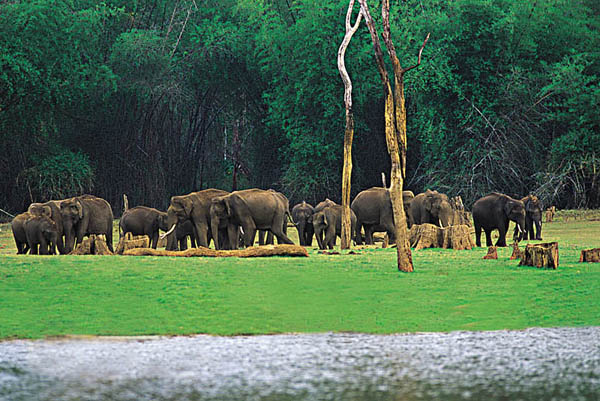
Also known as Thekkady, Periyar Kerala is a veritable paradise of elephants. Tourists planning to travel to Periyar National Park in Kerala can witness playful pachyderms, whose population is currently around 800. These gentle giants in the wild have made Periyar Lake their favorite haunt for frolicking in the water. Scores of them can be witnessed bathing and swimming here. The Indian female elephants do not posses tusks like their African relatives. They are also not as swarthy as their African counterparts.

Other inhabitants of Periyar include the leopard, wild dog, barking deer, mouse deer, Nilgiri langur (a primate), bonnet macaque, sambhar, porcupines, squirrels, gaur (Indian bison), wild boar and sloth bear. The population of tigers is also increasing appreciably. There are approximately 40 tigers in the area as per the latest reports. The tigers, along with the Nilgiri tahrs (a kind of a wild goat), are elusive creatures. To make your holidays in Periyar National Park more fruitful, an early morning visit, with luck on your side, could yield results.

Among the unusual species found at Periyar in Kerala are the flying lizard and the flying snake. With wings of orange or yellow, the flying lizard is seen as it glides from one tree to the other. The flying snake is also brilliantly coloured in yellow and black with a pattern of red rosettes. If you are planning your vacations in Kerala and looking forward to have a closer look at the wild side of life, then visit the Periyar National Park and Tiger Reserve. The best time to travel to Periyar National Park is between October to June.

Wayanad Wildlife Park

Posted by Rashid Areacode (9895261956) On 7:39:00 AM

The Wynad Wildlife Sanctuary in the southern Indian state of Kerala is a must for tourists looking forward to experience a bit of wilderness during their travel in Kerala. A part of the Wynad Plateau, this wildlife park in Kerala is famous for its tigers and leopards along with the other wildlife that one can find during holidays in Wynad.

The sanctuary is an extension of the Bandipur National Park in Kerala at its southern border. The region, which is a part of the Nilgiri Biosphere Reserve, was notified in the year 1973 as a wildlife sanctuary. The management of the park laid emphasis on creating scientific conservation methods that are complementary to the traditional lifestyle of the tribals residing in the region.

The Wynad Wildlife Sanctuary comprises two districts of Kerala in India. The park extends from the latitude 11°15' in the North to the longitude 76°30' in the East. There is a good road network that connects the sanctuary with the other important places in Kerala and the rest of India.

The climate of the region is very much influenced by the southwest monsoon that touches it in the months from June to September. There is good rainfall during the northeast monsoon too in the months of October and November. July receives the highest rainfall while February is the driest month here. April and May are the hottest months here while coldest months are January and February.

KERALA. Powered by Blogger.

Popular Posts